Why Traditional Restaurant Design Works — and Where It Goes Wrong
A plate of South Indian meals arrives with more than food on it. It brings a banana leaf, an order of serving that most diners know without being told, and a set of memories — a grandmother's kitchen, a wedding hall, a mess near a college or an office. When the room around that meal is grey laminate and a feature wall chosen from a catalogue, something doesn't add up, and diners feel it even if they never say so.
That gap is why traditional restaurant design keeps coming back in Chennai, and why it keeps going wrong. Owners can see the interest. They have watched a heritage-styled competitor fill up while the polished place next door stays half empty. What they rarely get told is the difference between a room that draws on tradition and a room that dresses up as it. This is how we think about that difference, using two restaurants we have designed and built — Mannan Mess in Egmore and Parva.
Why people are drawn to it
The room and the food tell the same story. Diners read a restaurant before they read its menu. Within a few seconds of walking in they have decided roughly what it will cost, how long they will stay, and whether to trust the kitchen. A traditional menu served in a room that agrees with it removes a doubt the guest didn't know they had. That is less about nostalgia than about consistency, and consistency reads as confidence.
It is built from things people already recognise. A kolam drawn at the threshold every morning. A red floor that stays cool underfoot. A cane chair that breathes in the heat. A niche in the wall for a lamp or a figure. None of these need explaining, and that is exactly their value: they make a new place feel familiar on the first visit, which is the visit that decides whether there is a second.
It photographs, for the right reason. Every restaurant now has two audiences — the people in the room and the people who see it on a phone. Traditional design tends to produce one strong graphic element: a patterned floor, a run of arches, a ceiling of cartwheels. A single clear idea photographs better than ten competing ones, and it is also easier to remember, which matters more.
It feels honest in a city of identical cafés. The same marble-effect tables, the same neon sign, the same hanging plants now turn up in every neighbourhood. A room rooted in where it is, and in what it serves, stands apart without having to shout. Guests notice that a place has a point of view, even when they couldn't describe it.
Tradition is not a theme
This is where most traditional restaurants go wrong. The brief says "traditional", and the room fills with brass pots, bullock carts, fake thatch, temple bells and a mural of a village scene, all at once. The result reads as a set, not a place. It also dates quickly: a theme is a single joke, and guests only laugh at it once.
The rule we work to is simple: borrow the logic, not the props. A traditional Tamil house was organised around shade, cross-ventilation, a verandah that softened the step from street to inside, and materials that aged well in heat and monsoon. Those decisions still make sense in a restaurant. A brass pot on a shelf is decoration. A verandah that lets the street fall away before you sit down is design.
A theme is a single joke. Guests only laugh at it once.
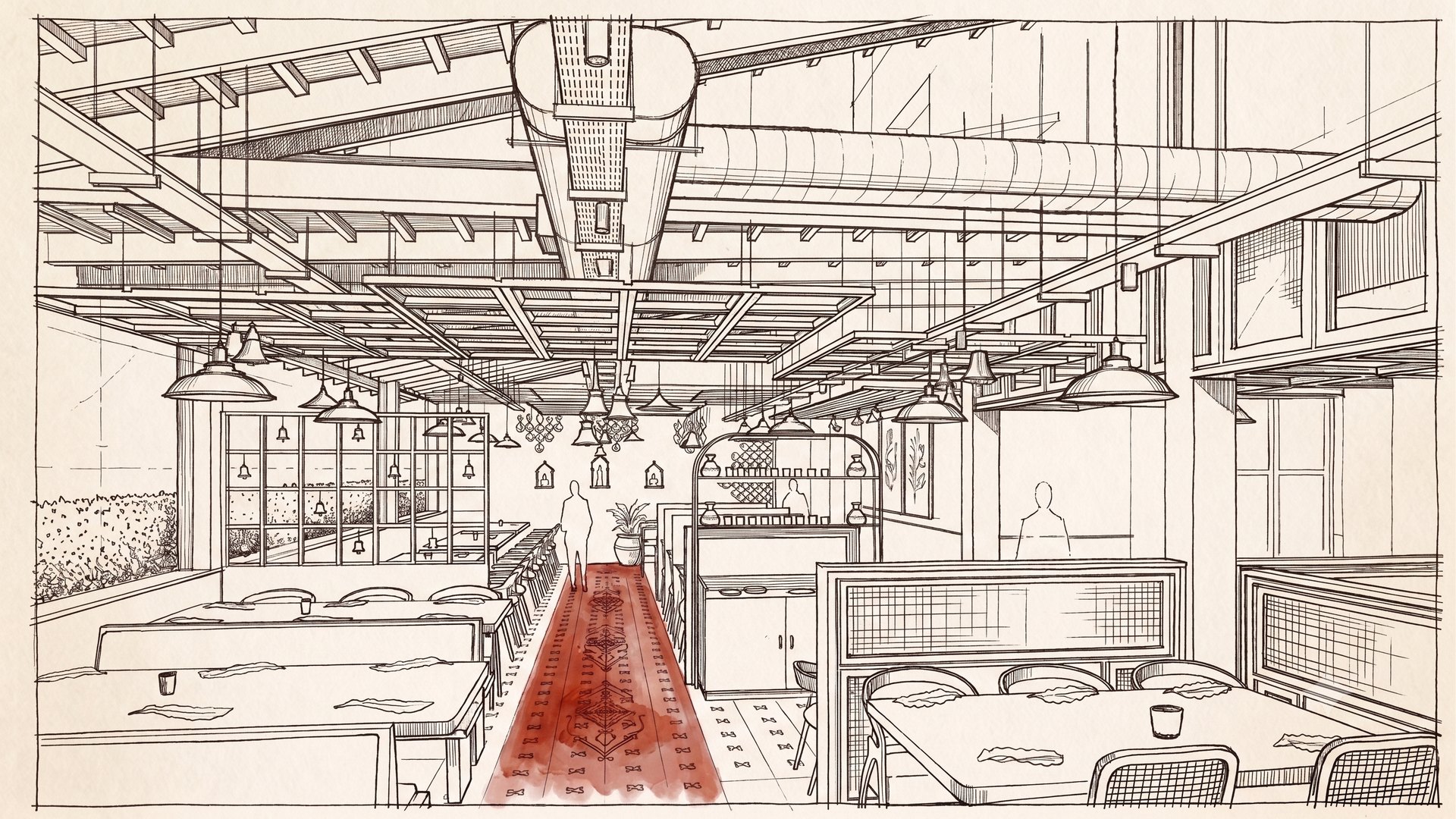
In practice that means choosing one or two traditional elements and committing to them fully, rather than sampling ten. At Parva, the brief drew on food and craft from across India, and the easy version would have been a themed interior borrowing a motif from every state. We designed instead for the feeling of a bazaar — a sequence of distinct zones held together by one circulation path and consistent detailing in the ceiling, floor and lighting. The arches and the cartwheel ceiling carry the identity. Everything else stays quiet so they can.
What carries tradition well
Some parts of a room carry tradition far better than others. Get these right and the rest can be plain.
The floor. Guests look down more than designers expect, especially in a long room. At Mannan Mess a red tiled runway with a white flower motif runs the full length of the dining hall, turns at the end, and leads the eye to the service counter. It does three jobs at once: it marks the circulation route that servers use, it gives a very long room a sense of direction, and it is the image people take away. A floor is also the hardest-wearing place to put a pattern, which makes it a practical choice as well as a striking one.
The wall. Rather than murals, Mannan Mess uses the kolam — interlocking loop patterns drawn in deep brown on a soft lime-white wall — with small arched niches holding figures between them. It is a motif nearly every guest has seen at a doorstep, scaled up and fixed in place. It does not need a plaque to explain it.
The ceiling. In a large hall the ceiling is often the biggest surface in the room and the most neglected. A timber coffered grid with cane infill panels brings warmth and scale down to the tables, and quietly hides services — ducts, cabling, fixings — that would otherwise be on show. At Parva the ceiling is where the identity sits: wheels and lanterns overhead, with the floor and walls kept calmer underneath.
The seating. Cane-backed chairs and long upholstered banquettes recall the thinnai, the raised seat on the verandah of a traditional house, without copying it. Cane matters in Chennai for a practical reason too: it doesn't trap heat against the back during a long lunch.
The light. Warm, low and in pools rather than flat and even. Brass and timber pendants over each table make a big hall feel like a series of smaller rooms, and they flatter both the food and the people eating it. Bright, even white light is the fastest way to make a traditional room feel like a canteen.
The threshold. Traditional houses never let you walk straight from the street into the main room. A verandah, a step, a change of floor or a screen of planting does the same work in a restaurant: it slows the guest down and tells them they have arrived somewhere. At Mannan Mess, columns with a green dado, an old-style timber door and a band of planting along the glazing do this along the edge of the hall.
Where tradition has to give way
A restaurant is a working building first. The parts of it that guests never see are the parts that decide whether it survives, and none of them should be designed around nostalgia.
- The kitchen and the service line. A mess hall runs on speed — fast turnover, communal seating, a kitchen that has to keep up through every service. Food has to enter the room, reach the table and be cleared without crossing paths. That planning comes before any material is chosen, and tradition has nothing to say about it.
- Cleanability. Every traditional surface has to survive a commercial cleaning routine, twice a day, for years. Textured lime finishes go where hands and trays do not; floors and table tops are specified for wear, not for look alone.
- Air conditioning and services. Traditional houses relied on cross-ventilation. A full restaurant in Chennai's climate needs proper air conditioning, which then has to be integrated into a ceiling designed to carry it — not bolted onto a heritage detail as an afterthought.
- Acoustics. Hard floors, plaster walls and a full room at lunch can get very loud. Soft upholstery, cane, timber ceilings and planting all help absorb sound; it is one more reason those traditional materials earn their place.
The way we describe it to clients: a traditional face on a modern engine. The guest sees the floor, the kolam and the cane. The kitchen, the services and the cleaning schedule behind them are as current as anything in a new-build café.
A note on budget
Traditional design is not automatically expensive, and it is often cheaper than it looks. One committed element — a floor, a ceiling, a wall motif — does more than a room full of bought decoration, and the money it saves can go into the parts that actually affect operations: the kitchen, the exhaust, the air conditioning, the lighting. What does cost money is changing your mind halfway through. Deciding early which one or two elements will carry the identity is the single best way to protect a budget. Our guide to restaurant interior costs in Chennai goes into the numbers in more detail.
Before you brief a designer
If you are planning a restaurant with a traditional menu, these are the questions worth answering first:
- Which tradition, specifically? "South Indian" covers a lot. A Chettinad table, a Brahmin meals hall and a Kerala toddy-shop menu want very different rooms.
- What is the one element guests should remember? If you can't name it, the design will try to say everything.
- How fast do tables need to turn? A mess at lunch and a family dinner restaurant need different seating, spacing and lighting, even with the same menu.
- Who will clean it, and how often? Specify for the maintenance you will actually get.
- What should still feel right in five years? Logic ages well. Props don't.
The short version
People are drawn to traditional restaurant design because it makes the room agree with the food, it feels familiar on a first visit, and it stands apart from the generic. It works when it borrows the logic of traditional buildings — shade, thresholds, materials that suit the climate, one strong idea — and fails when it borrows only the props. Put the tradition where guests look, put modern engineering everywhere they don't, and decide early what the one memorable thing will be.
You can see how this played out in the Mannan Mess and Parva projects.

Founder, Terra Architecture + Interior — M.Arch, Chennai.

